Microplastics

Integrated research on the identification, distribution and removal of microplastics from the environment and wastewater.

Our laboratory conducts integrated research on microplastics and plastics in the environment, focusing on particle identification and quantification, spatial distribution patterns, and the development and assessment of approaches for microplastic removal from wastewater.

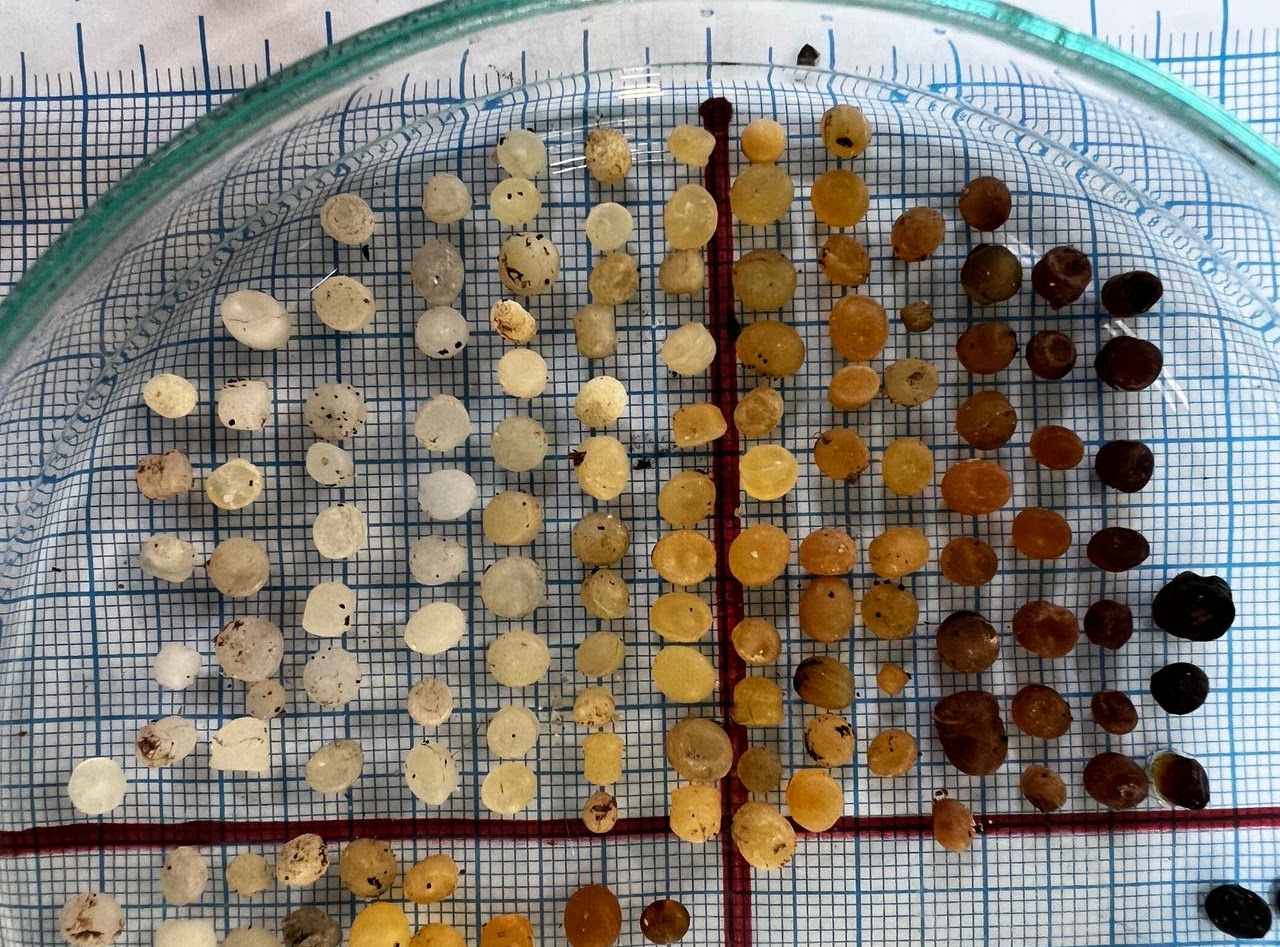
Microplastic particles sorted by color on a laboratory counting grid

Research posters

Two studies from the lab, from the stream that delivers microplastics to the sea to the debris that settles on the floor of a marine protected area. Read the summary, view the full poster in the browser or download the PDF.

Conference poster

Seasonal Pulses of Microplastic Emissions to the Mediterranean Sea: the Na'aman Stream (Israel) Case Study

Annelise Ferry, Revital Bookman, Yael Segal, Dror L. Angel

Most marine microplastics originate on land, yet Mediterranean streams remain poorly quantified as delivery pathways. This study sampled sediments along the Na'aman Stream south of Akko, at its outlet and on the nearby beach, during the dry and rainy seasons of 2021, and classified every particle by size, shape, colour and polymer.

Microplastics accumulated temporarily about 50 metres upstream of the outlet, reaching 1,148 plus or minus 388 particles per kilogram of dry sediment in autumn, before the first rains flushed the system. Fragments dominated, followed by foam and film, pointing to consumer products and packaging waste within the watershed. To our knowledge this is the first systematic quantification of microplastics in an Israeli freshwater stream.

  • Five sampling sites along stream, outlet and beach
  • Dry and rainy season sampling, 2021
  • Sieving at 5000, 1000 and 300 microns plus FTIR polymer analysis
  • Peak of 1,148 particles per kg dry weight upstream of the outlet
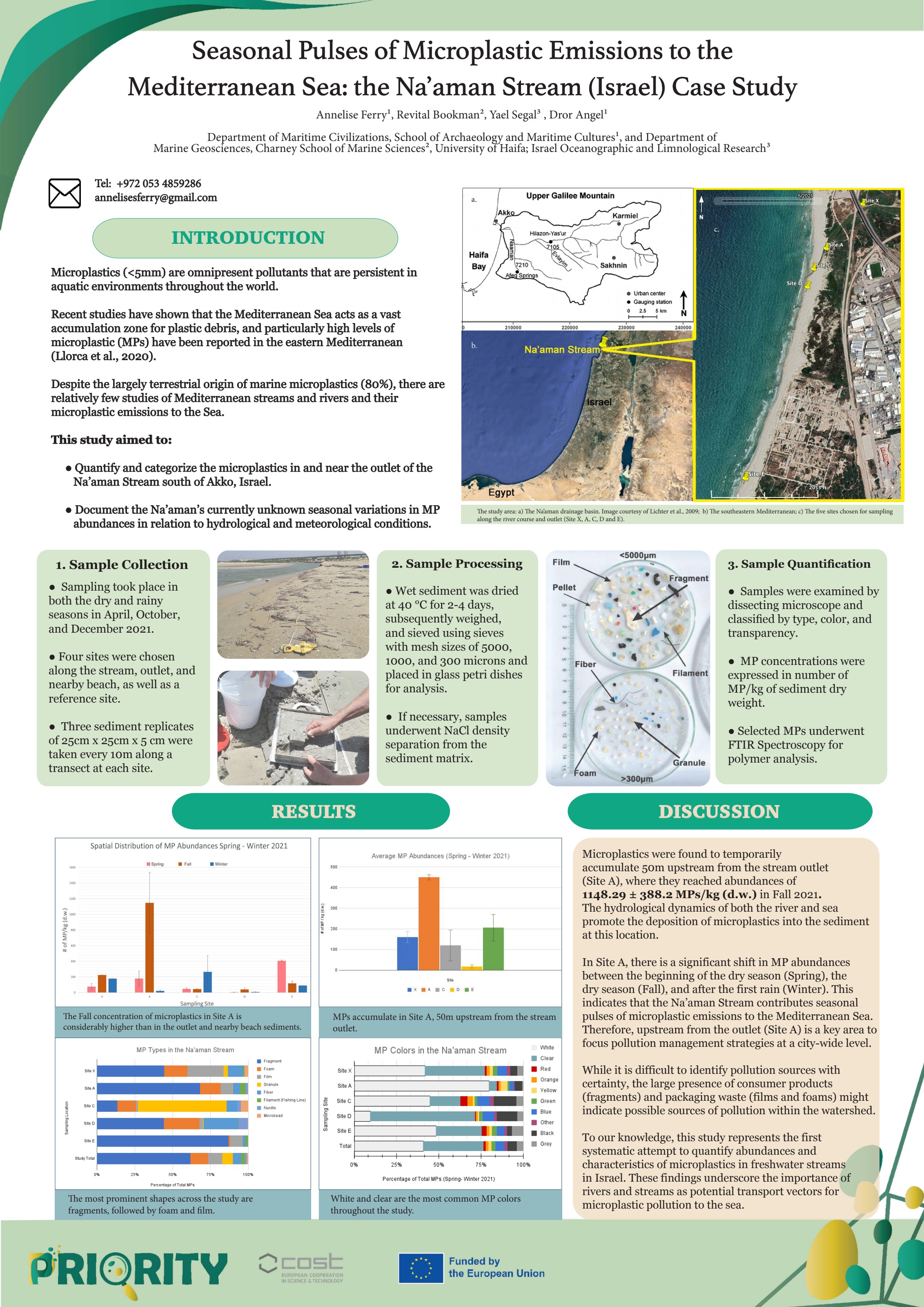
Research poster with maps, field photographs and bar charts describing microplastic abundances along the Na'aman Stream
Poster preview. Selecting it opens the full PDF in a new tab.

Conference poster

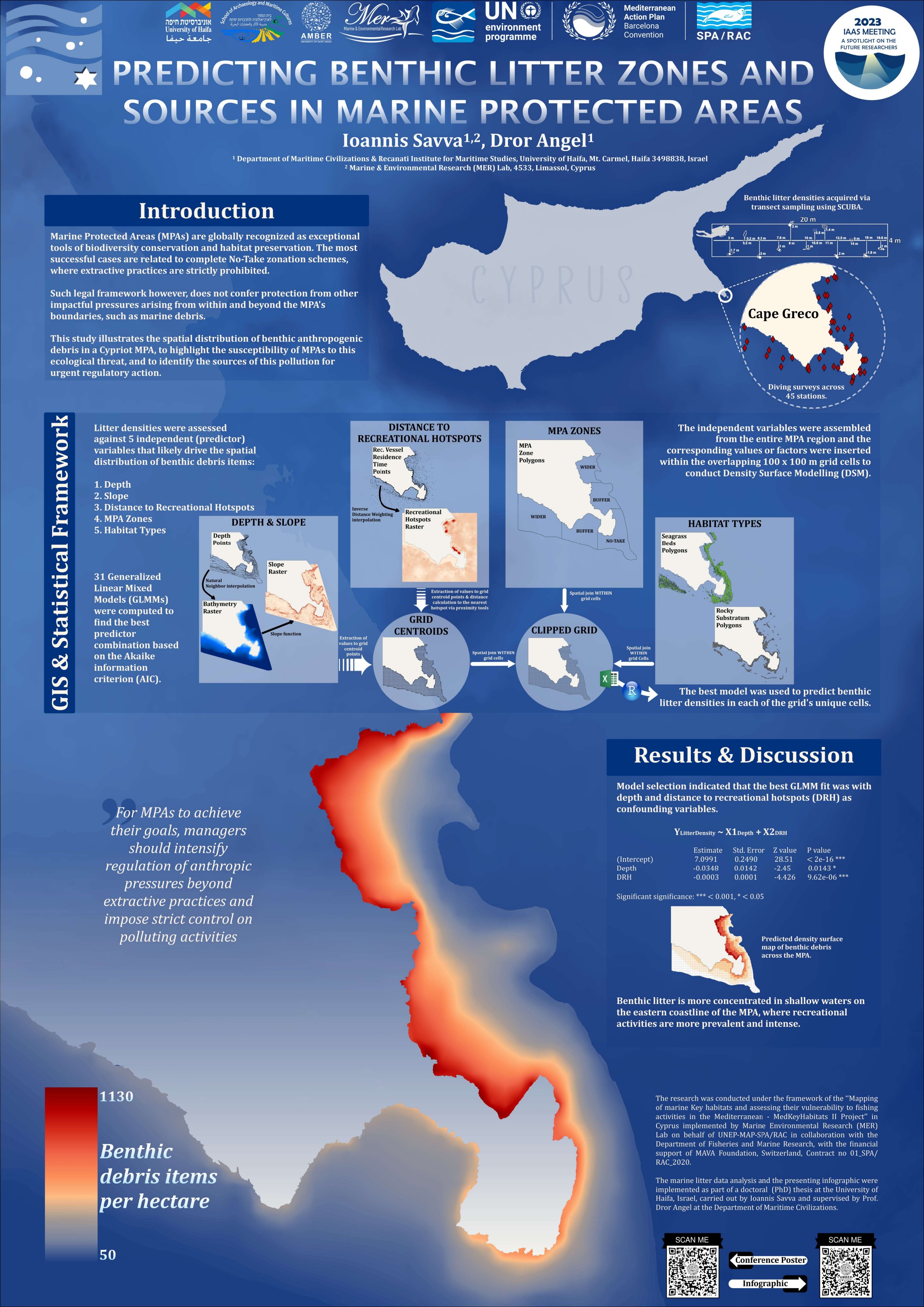
Predicting Benthic Litter Zones and Sources in Marine Protected Areas

Ioannis Savva, Dror L. Angel

Marine protected areas restrict extraction, but they offer no shield against plastic and other debris arriving from within and beyond their boundaries. Using SCUBA transects across 45 stations in a Cypriot marine protected area, this work mapped the density of benthic anthropogenic debris on the seabed.

Thirty one generalized linear mixed models were compared, and the best fit combined depth with distance to recreational hotspots. Density surface modelling on a 100 by 100 metre grid predicted up to 1,130 debris items per hectare, concentrated in shallow water along the eastern coastline where recreation is most intense. The result argues that protected area managers must regulate polluting activities, not only extractive ones.

  • 45 SCUBA transect stations in a Cypriot marine protected area
  • Depth, slope, habitat, zoning and distance to recreation as predictors
  • 31 generalized linear mixed models compared by AIC
  • Up to 1,130 debris items per hectare predicted in shallow eastern waters
Research poster with seabed maps, statistical tables and a predicted density surface of benthic litter in a marine protected area
Poster preview. Selecting it opens the full PDF in a new tab.

Focus areas

  • Particle identification
  • Microplastic quantification
  • Spatial distribution patterns
  • Wastewater pathways
  • Removal technologies and assessment